by Takashi Hayami, Art Critic
(From the exhibition pamphlet for the solo exhibition at Shimane Art Museum Gallery, 2000)
From 1985 for almost a decade, Ryuji Moriyama produced works using a paper cut-out technique, cutting colored paper and adhering it to the canvas. Moriyama’s cut-outs derive from Matisse. Matisse’s aim was to unify the process of drawing forms with the process of painting colors. Moriyama’s cut-outs are fundamentally similar.
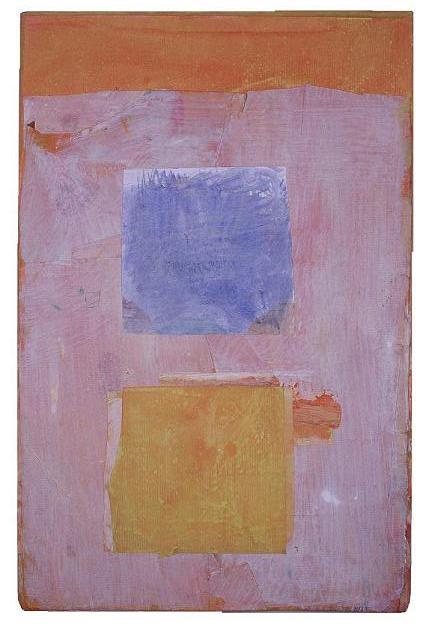
Colored and cut-out rectangular and circular forms/colors are arranged on the canvas. From a certain period, the frequently used compositions have become largely fixed. A horizontal frieze-like band is placed at the top of the screen, and beneath it are two main large rectangles. This composition fulfills two functions. One is, as can be understood when recalling landscape paintings, to draw the upper part of the screen, which suggests distance, forward, thus flattening the entire surface. The other is to make the screen subtly fluctuate by making the upper part appear heavy.
These motifs gently float within the screen, overlapping or shifting vertically. In the early days of using the cut-out method, this sense of floating had a movement that expanded towards the center or spiraled outwards from the center. This also seems to have been a method to freely adjust the connection between the “ground” of the screen and the “figure” of the motif, compensating for the tendency of the cut-out method to separate the two. In recent years, such movements have been refined, becoming more subtle. Colors with similar hues are placed adjacent to each other, while the overall composition presents a contrast of opposing hues. Therefore, while the colors are harmoniously stable, they create a strong sense of color.
All motifs are arranged parallel to the plane of the canvas. This is frontality. It means confronting the viewer directly. For example, all the murals in Byzantine church art exhibit frontality. Jesus and the saints face the believers who visit the church directly, as if they are in a world contiguous with the viewer. Modern art is when painting loses this frontality and becomes an autistic, autonomous painting as a fictional world separate from the viewer. Picasso’s “Les Demoiselles d’Avignon,” with its intensely gazing women, incorporates a Byzantine-like frontality. 20th-century abstract painting did not simply flatten; this frontality was precisely a crucial issue. Frontality is an important element that detaches painting from a fictional world and positions the viewer in the same real world.
Moriyama’s paintings possess a sense of reality that draws the viewer in, due to their thorough frontality, which makes the viewer feel continuous with the work. Abstract painting sometimes sought further realism from this point, abandoning frontality and developing into literally realistic objects. Moriyama’s work is not like that. This is because frontality and form/color are important languages in Moriyama’s paintings.
In paintings from the cut-out period, variations in uneven or flat application of paint served to complement the hard outlines of the forms. About four or five years ago, Moriyama returned to painting without relying on cut-outs. Here, the motifs are narrowed down to the upper frieze-like band and the two main rectangles, with subtle rectangles appearing and disappearing as they overlap these. The “ground” and “figure” are more harmonized, and the expressiveness of painting, in which form and color are united, emerges. Frontality continues to play a crucial role here. Ryuji Moriyama’s painting is about realizing painting, not about making painting into a mere object.
(Takashi Hayami, Art Critic)