( before a work comes into being)
Outside narrative, outside purity.
If Modernism was the pursuit of “what a painting is,” my inquiry focuses on the very process of “how a painting comes into being.
Modernism closed inward through the purification of form, while postmodernism, arising from that impasse, relied on external narratives.
Yet neither possessed a perspective that addressed the actual “phenomena” occurring within the painting—the activation of visual laws.
My inquiry stands precisely on the ground of addressing this missing “phenomenal layer.”
The movement of visual laws within a painting can be understood through three states:
- Pre-generation: The state in which visual laws have not yet been activated.
- Zensō (Pre-layer): The state in which visual laws remain activated and in motion.
- Kōsō (Post-layer): The state in which visual laws converge and achieve stability.
My position lies within the Zensō (Pre-layer)—a realm in which a center exists, while visual laws remain in motion.
The Pre-layer is the wavering before form.
The center arises in this wavering and settles as visual law.
In this shift, structure triggers emotion, preceding language.
Even after the adjustments are finished and time has passed, there are moments when the surface seems to faintly tremble. That trembling draws my attention, sending me back and forth between the act of painting and the judgment of observing.
A structure in which the center has not yet emerged within the tremor. I named the state in which judgment and action waver upon the visual laws Before-Origin.
Because I sensed that an order was already at work on the side of the world, there was no need to decide the meaning in advance. As long as the cycle of judgment → action → change → judgment continues, the surface stays alive. Trusting that cycle made it unnecessary to raise meaning.
When postmodernism became dependent on external contexts, I needed to return to the layer before meaning arises and touch the source.
In the process of exploring the center, I simultaneously created a “converging center,” naturally generated by visual principles, and a “center as an initiating point” that triggers the act of creation.
The doubling of the center—and the tension between convergence and anti-convergence—allows the pictorial field to sustain a state of tension and oscillation. I call this state the “pre-layer.”
“All-over” works present a uniform field devoid of a center; the differences that emerge there—bleeding, hues, textures—are fluctuations of the medium itself.
The oscillation of the pre-layer, however, is not a fluctuation of the medium, but of the generative process itself.
Modernism pushed the purification of form to the extreme, erasing structure and turning the work inward. Postmodernism sought its grounding externally, rendering structure unnecessary. Neither approach is capable of addressing the generative process of the artwork.
Observing a phenomenon and making a judgment, engaging with it through the body, seeing the resulting change and judging again. Eventually a center appears, the changes grow, and in response, judgment and action repeat. A structure may emerge.
Modernism stalled inside; Postmodernism looked outward.Both missed the layer where visual laws keep operating—I named it the Zensō (Pre-layer).
Visual laws are the eye’s automatic drive to form meaningful unity.Activation is the start of this drive; Convergence its stabilization.
Zensō (Pre-layer): Visual laws are active but not yet converged.
Kōsō (Post-layer): Visual laws are in the state after convergence.
Case Studies: How the Pre and Post Layers Manifest in Paintings (→ View the Map)
Artist Map (artists and their positions)
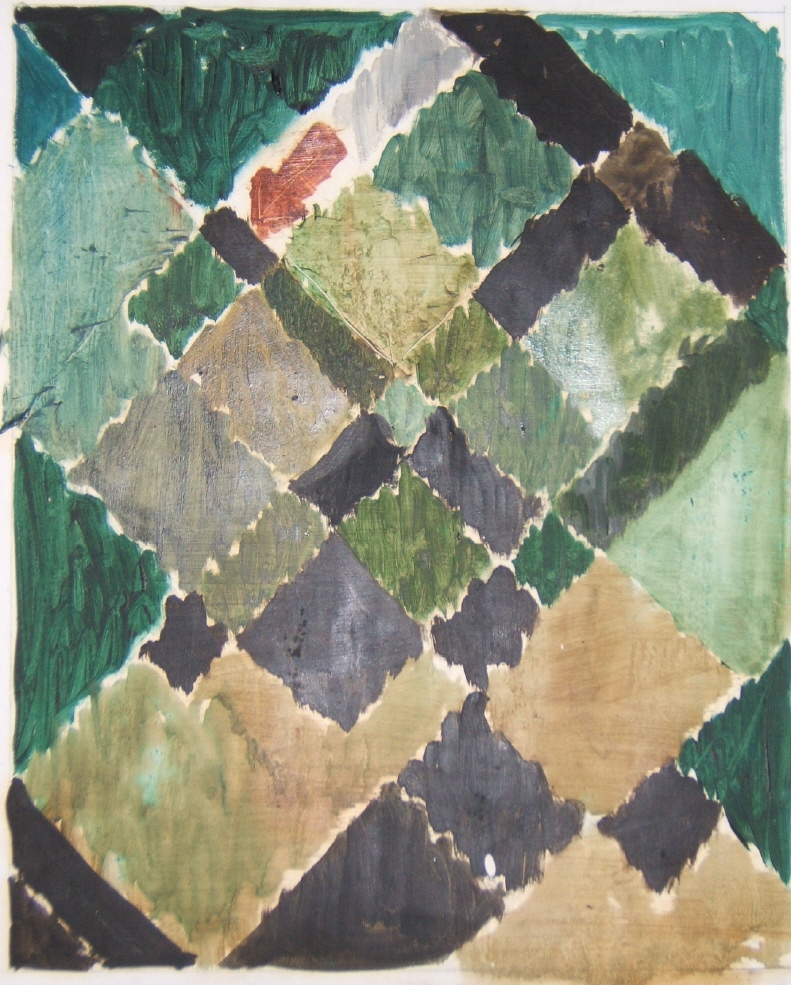
Meiro 1980
Maze (1980) — “Pre-conscious structure”
The Declaration ( toward the outside)
Internal Terms (the internal vocabulary)
Q&A (the entry support)
Narrative dominates today, but I do not stand there.
History (Visual Laws)
Zensō (Pre-layer) / Kōsō (Post-layer)