My Pursuit of the Center in Painting
A Declaration of Post-Postmodernism
Modernism sought the autonomy of painting, but closed itself within.
Postmodernism searched for justification outside the work, and in doing so, forgot emotion.
I aim to preserve the autonomy of painting while fusing it with intention.
Through the device of the center, I bind the structure of the work with my will,
connecting the inside and the outside.
This is my Declaration of Post-Postmodernism.
As a result of Formalism’s pure pursuit of the essence within a work, it was able to explore but lost its ability to unfold. By purely pursuing what color, form, and the elements of painting are, narratives and human feelings other than structure were considered extraneous.
Even when McCracken spoke of a myth, it emerged from the structure itself, and he did not bring in the words or images of a myth from the outside.
However, because it pursued to the point where it could no longer unfold, Postmodernism was forced to seek the basis for a work in external “context,” rather than developing from within the structure.
I believe, however, that the power of words has become too dominant.
As a person who came from the countryside, longing to be like Van Gogh, I felt a sense of conflict with this era. Why did words take precedence over emotion? If I were to put what I was trying to do into words, I was attempting to defy the times and reconstruct the essence: the structure.
This is where I introduced the concept of “the center.” To me, the center is both a structure and a device for expressing my will.
By intentionally introducing the center into my work, I have fused my will with the work through a structural center, not through words.
My works are self-sufficient, supported by their internal structure, and do not need to be propped up by words or context like Duchamp’s “Fountain.”
Even if words take precedence over the work in Postmodernism, my words never take precedence over my work.
September 2025 Ryuji Moriyama
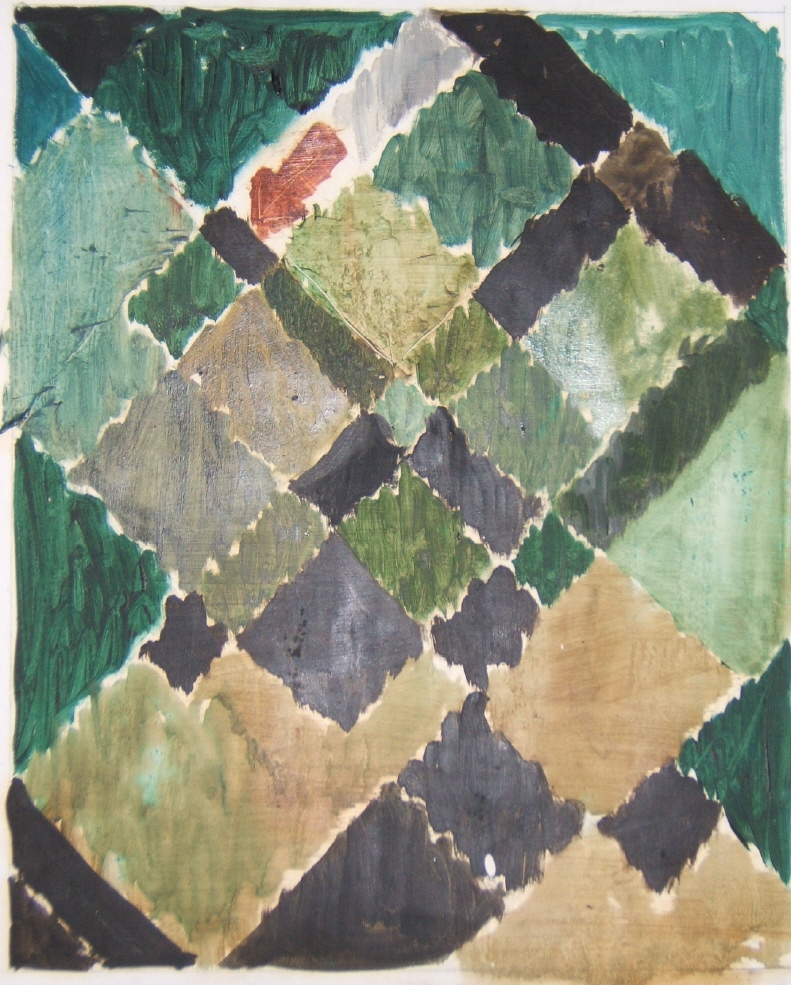
Meiro 1980
Maze (1980) — “Pre-conscious structure
System and Work
The Current State and Its Origins
Until recently, I didn’t understand what Postmodernism was and felt only confusion and anxiety about it. However, I’ve come to understand that it’s about doubting the center and authority, and consequently, it led to the recognition of diversity and the declaration that grand narratives were over. Perhaps it began when Duchamp pointed to a propeller and said painting was dead. Or maybe when Pollock invented all-over painting.
Modernist painting became an object, like John McCracken’s work, or something even further beyond that. The tendency to create works based on conceptual and contextual frameworks became stronger. I believe this has become a system where doubt is considered correct.
The system I’m referring to is the situation surrounding the art world—the leading players, including museums, galleries, curators, and critics. Postmodernism began as a reflection on Modernism and embraced various works with a stance of doubting authority. However, when that becomes a system, it leads to the exclusion of works that do not doubt, labeling them as old-fashioned. Don’t systems tend to protect themselves by discarding other possibilities?
My Stance
When I was a student,painting was already considered outdated. It was a time when I was asked, “Are you still painting?” For someone who came from the countryside, longing for Van Gogh, it was a completely confusing situation. However, modernist painting captivated and enchanted me. While I had an inner joy for painting that I could clearly feel, in the outside world, amid the dizzying trends of art, I desperately searched for a way to establish my own expression. I thought that if I piled up one work after another that felt just right, a light might appear. I approached my work with a mind to just focus on the current piece.
At that time, I realized that by looking at the relationship between the central object and its surroundings, or the relationship between the central object and different elements, or the relationship with the whole, the work becomes easier to read. This was at a time when all-over painting was already considered classical. However, no matter how much the times dictated or how popular something was, I could not create something that didn’t feel right to me. I had no choice but to pursue the center with a clinging desperation.
At first, my engagement with the center was like groping in the fog, or doubting if it was the right path. But as I slowly continued, it gradually turned into a conviction within me. By placing a center, my work might be compositionally restricted, but I thought it would make other areas more free. It’s like how a kite can fly higher with a string.
And I thought I could incorporate various artistic achievements. This is not a simple citation, but about using the center as a filter to incorporate various achievements. I was clear that this was different from a simple citation. If I only borrowed surface forms, it would be easy to explain, but I believe there would be no depth. My citations incorporate various achievements not to show them off, but to make the work deeper and richer. This is related to a qualitative problem that is difficult to put into words.
The System That Discarded the Center
Currently, Postmodernism has become the system of the art world. In other words, the pursuit of the center has become completely unacceptable. While they claim to embrace everything with diversity, perhaps accepting the center is the one thing they cannot accept. This is likely because they feel a sense of authority centered on the purity and universality that Modernism pursued. But now, Postmodernism itself has become the authority, and it’s not allowed to question it. To doubt doubt might be to believe.
I believe in the center not for a fixed authority, but because it is visually very convenient for interpreting the creativity that anyone can possess.
I think I’m not rejecting Postmodernism, which is uncomfortable for me, but rather incorporating it in a sense of diversity. In other words, I intend to take a stance of neither denying nor affirming it. However, history proves that the same system doesn’t last forever.
Is art just about words?
The integration of essence and concept.
Essence, indeed, exists. When you see a painting and feel an indescribable emotion, that is the essence. The words that describe it, those are the concepts.
Once, in a department store, I was moved by a painting so far away that I couldn’t make out what was in it or who the artist was. When I rushed closer, I saw it was a Picasso poster. The emotion I felt was the essence, and the fact that it was a Picasso painting was the concept.
In other words, the essence exists before the concept.
The center is structure and will.
I have said that essence precedes concept. This means that emotion comes first, and words are used to explain it. So, when I consider what the source of emotion is, I believe it is the painting’s color and form arrangement—in other words, its structure. This is not about context or social issues. Up to this point, I am the same as Formalism.
However, I have introduced the concept of the center.
Why did I introduce the center? One reason is an inner necessity; the dissonance between the era and myself created a conflict, and I made the center the foundation of my work in my attempt to paint a good picture. I also thought that the center could serve as a filter to incorporate various art-historical achievements. And the most important reason is that I have always felt a sense of discomfort with the current situation where context takes precedence over emotion (essence).
The source of emotion is not in the context but in the structure. The center is a visualization of that. Why can I say that? The center attracts the eye and creates a hierarchy and structure on the canvas. Intentionally placing the center is an expression of my will to create a structure.
To me, the center is both a structure and a will.
By placing the center, I am expressing my will in relation to the mainstream of art history, Formalism and Postmodernism.

MON(A gate) 1981
A premonition of emerging structure”
Post-Postmodernism Declaration: Critical Examination and Response (Q&A)
Q1. Is this not merely a return to Modernism?
A. I understand where Modernism ultimately led. While Modernism pursued form and purity, my goal is to reconstruct structure to generate emotion, to heal myself, and to engage the viewer through a common language. That is to say, my purpose and direction are fundamentally different.
Q2. Are emotion, essence, and will too ambiguous? What is the mechanism for them to become a universal structure?
A. Will becomes a part of the work through the context of intentionally placing the center. However, the center itself is supported by an objective structure, meaning visual laws. Even if emotion itself differs from person to person, the structure supporting it is based on visual laws common to everyone. This is how the phrase ‘The Center is Structure and Will’ came to be.
Q3. Since Postmodernism is a universally accepted global consciousness, is the Declaration itself not impossible?
A. I understand the argument that if everything is relative, universal truth cannot be established. However, I create not based on the accuracy of an external theory, but on the inner truth that emotion precedes language.
This Declaration is a response to the personal struggle I faced in the age of Postmodernism. The work is a form of self-healing, but it is bound to the structure by the device of the center and is opened to the world. This Declaration is a deeply felt necessity to protect both my past and future works.
Q4. I am not moved by your work, nor do I see any technical skill.
A. I am not trying to achieve anything technically advanced. My attention is focused on connecting the will and the structure based on the conviction that directness startles people. While it is regrettable if viewers are not moved, I will simply continue to repeat the structure until I am satisfied.
Q5. Is the structure, in the end, merely your personal preference (shumi)?
A. Structure is the foundation of the work that precedes context. A foundation is not called a personal preference.
Q6. Is the center not a revival of authority?
A. The center is a term that represents visual laws. It is not for the sake of authority, but a device for reading based on visual laws.
Q7. If it is about self-healing, are you not rejecting communication?
A. I recognize that the nihilistic pathology brought about by Postmodernism is a pathology shared not only by me but by the entire era. I believe this is something that all of us living in the modern age share to a greater or lesser extent. This self-healing is the complete opposite of abandoning communication.